During the five years from May 1940 to May 1945 several thousand Allied airmen, forced to abandon their aircraft behind enemy lines, evaded capture and reached freedom, by land, sea and air. The territory held by the Germans was immense – from Norway and Denmark in the north, through Holland, Belgium, Luxembourg to the south of France – and initially there was no organisation to help the men on the run. The first one to assist the evaders and escapers (‘E & E’ as the Americans called them) was the PAT line, along the Mediterranean coast to Perpignan and down the Spanish border; named after a naval officer Pat O’ Leary, from 1942 it became the PAO line.Next was the Comet line, from Brussels to the Pyrenees. Thousands of brave people were to be involved for whom, if caught, the penalty was death. Theirs is a stirring and awe-inspiring story. Respected historian Oliver Clutton-Brock has researched in depth this secret world of evasion, uncovering some treachery and many hitherto unpublished details, operations and photos. It is a tremendous reference work, written in his own colourful style with numerous anecdotes, which fills a gap of knowledge formerly unavailable to historians, professional or amateur. Packed with information, key figure biogs and listings – 2,094 evaders identified – this is a valuable testimony to the courage of all those involved.
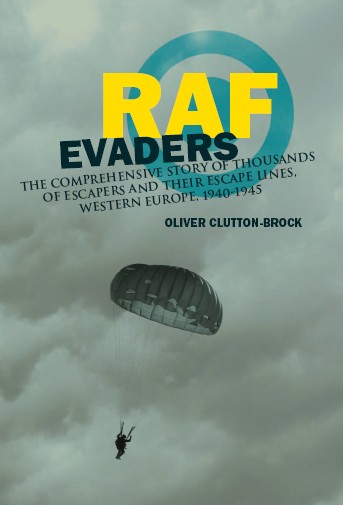
RAF Evaders
The Complete Story of RAF Escapees and Their Escape Lines, Western Europe, 190-1945
Oliver Clutton-Brock
£35.00
Out of stock
Categories: Aviation, Bomber Command, WW2.
You might also like
-
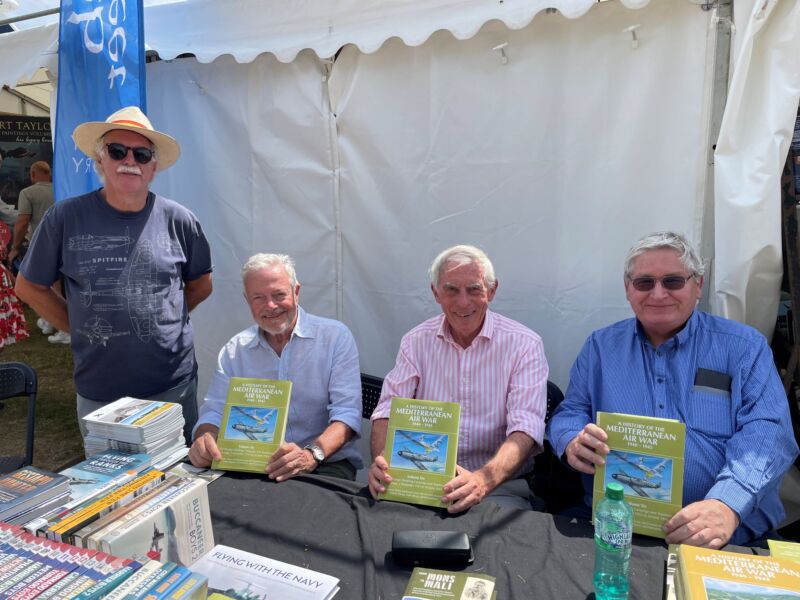
A History of the Mediterranean Air War, 1940-1945, Volume One
Christopher Shores
Giovanni Massimello and Russell Guest
This is the first volume of a seminal series which aims to give full coverage of all aspects of aerial operations throughout the whole of the Mediterranean area during the Second World War. Operations directly over the main battlefronts are dealt with on a daily basis. However, to allow a clearer view to be obtained of operations elsewhere in the theatre, or of a different nature, separate chapters deal specifically with the night bombers, the air defence of the base areas, and the naval co-operation activities. Wide use of maps will be made throughout this and subsequent volumes together with a considerable number of photographs integrated into the text, many never seen before. Long awaited by many, if any work can be said to be comprehensive and definitive, this is it.
£50.00read more > -
A Doctor’s War
Aidan MacCarthy
As an RAF medical officer, Aidan had served in France, survived Dunkirk, and was plunged into adventures in the Japanese-American arena comparable with those of famous war heroes. Interned by the Japanese in Java, he helped his fellow prisoners with amazing ingenuity in awful conditions. En route back to Japan in 1944, his ship was torpedoed but he was rescued by a whaling boat and re-interned in Japan. His life was literally saved by the dropping of the Nagasaki atom bomb. He was then eyewitness to the horror and devastation it caused. This is an almost incredible account written with humour and dignity.
£8.99read more > -
Poles in Defence of Britain
Robert Gretzyngier
Fifteen years since it was originally published, Grub Street is proud to present the re-issue of Poles in Defence of Britain. To the Polish volunteers who were to fly and fight so brilliantly and tenaciously throughout the Battle of Britain, the United Kingdom was known as ‘Last Hope Island’. Many lost their lives, such as Antoni Ostowicz, many achieved glory and became aces – such as Glowacki, Skalski and Witorzenc. The RAF came to depend on these men, with over 100 Polish pilots supporting almost thirty fighter squadrons, most especially 302, 303 and 307 (night fighter).
£15.00read more > -
A Most Secret Squadron
Des Curtis
Des Curtis was one of the founder members of 618 Squadron. Formed within days of the illustrious 617, 618’s primary objective was to mount a daylight low-level attack by Mosquitos on the German battleship Tirpitz within hours of the attack on the Ruhr dams. The operation, codenamed Operation Servant, was given top security classification, to the point where the subject was excluded from the minutes of the meetings of the Chiefs of Staff of the air and naval forces. The author reveals the dilemmas and conflicting priorities existing to the highest levels, setting out in detail the technicalities of developing the ‘bouncing bomb’. He also writes first hand about the tactical problems of getting to and from the target; and the tensions and strains endured by the Mosquito crews themselves, as they took the war to the German U-Boats within the sight and safety of their bases.
£20.00read more >


Reviews
There are no reviews yet.